
On November 14th at just around 20:00UTC, something broke.
The workforce intelligence vendors didn't send out emails saying "hey, our data quality just got worse." The dashboards still looked the same. The coverage didn't change. But underneath, the refresh engines that keep workforce data accurate started falling behind.
We see this from both sides at Live Data Technologies. We track employment status and job changes for roughly 160 million people. We talk to the companies buying this data for competitive intelligence, for investment signals, for talent tracking. And we've watched a slow-motion quality crisis unfold across the market as LinkedIn's enforcement infrastructure finally caught up with the vendors who'd been scraping it for years.
The vendors most affected won't tell you this is happening. But the buyers are starting to notice that their insights feel stale, that the signals lag the news instead of leading it, that the "real-time" workforce data they're paying for is no longer real-time.
What Changed
LinkedIn has been fighting scrapers for years. But the enforcement that rolled out in late 2025 was different in kind, not just degree.
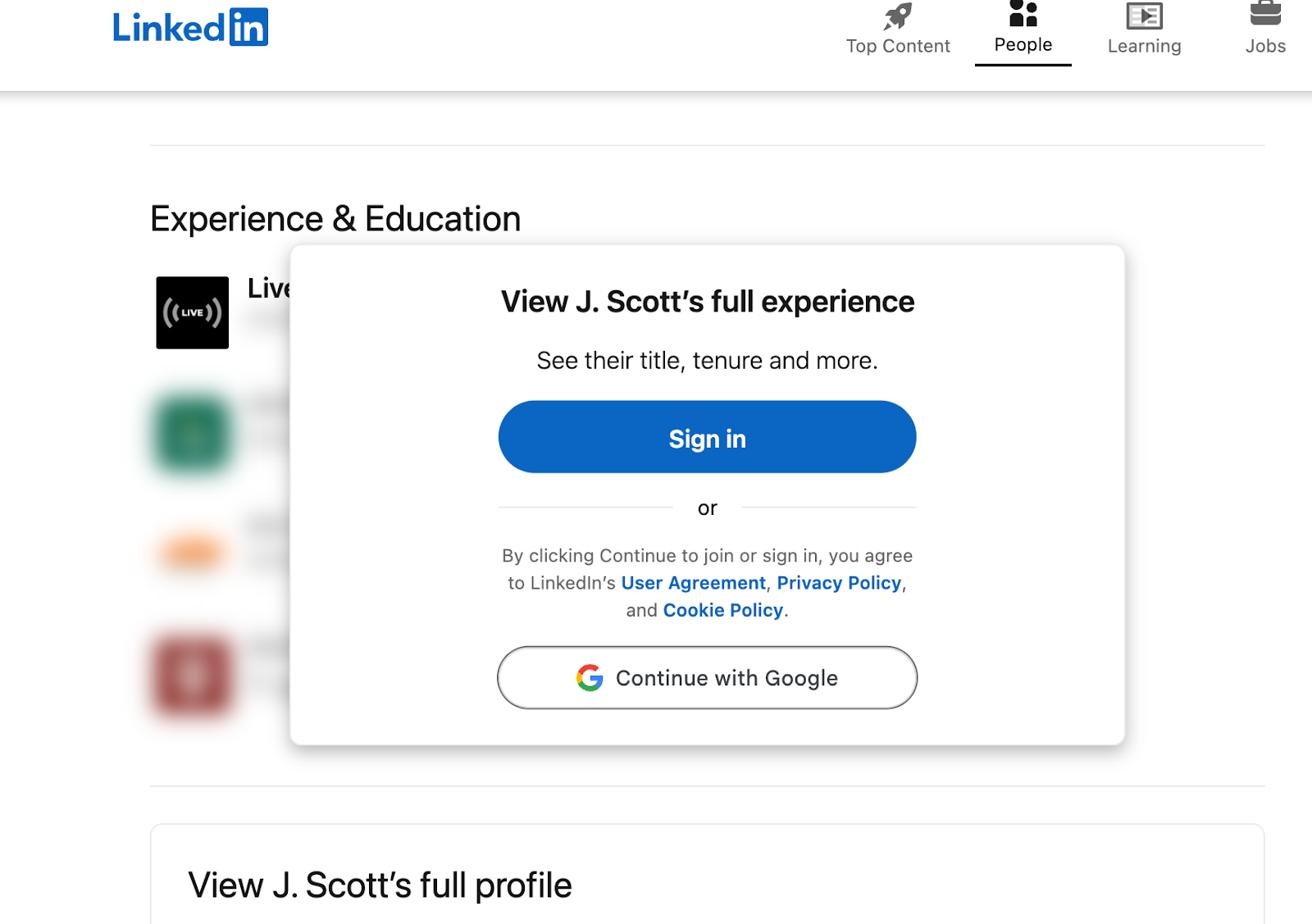
It started with what I call the “Great Blur.” If you visit a LinkedIn profile without being logged in, you no longer see employment history. You get a name, maybe a headline, and then a login wall. Scroll down and everything blurs out. "Sign in to see the user’s full experience." This matters because the simplest, cleanest way to collect workforce data at scale was always to crawl public profiles without authentication. No fake accounts, no session management, no risk of getting banned. Just fetch the HTML and parse it. That door is now closed. If you want employment history, you need to be logged in, which means you need accounts (something extremely uncouth in the data aggregation game and very against LinkedIn’s ToS), which means you're playing a game LinkedIn has gotten very good at winning.
The detection systems have gotten genuinely sophisticated. LinkedIn's scripts now check whether browsers are lying about what they claim to be. They cross-reference GPU signatures against claimed operating systems. They verify that CPU core counts match the hardware a browser says it's running on. When a bot running on a Linux server claims to be Chrome on macOS, the fingerprint inconsistency gets flagged. The script literally checks: did this browser lie about its OS?
Then there's behavioral analysis. LinkedIn can distinguish human browsing patterns (irregular timing, actual reading, unpredictable navigation) from bot patterns (mechanical regularity, consistent intervals, predictable sequences). A human might spend four minutes on one profile and thirty seconds on another. Bots tend toward regularity that machine learning models can identify trivially.
According to LinkedIn's Transparency Report, their automated defenses now block 97.1% of fake accounts proactively, before anyone reports them. That's not a typo. They're catching nearly everything before it can operate at scale.
Can you still pull data from LinkedIn? Sure. If you're a sales rep running a Chrome extension to enrich 50 leads a day, you'll probably be fine. If you're a recruiter manually checking profiles, no problem. But if you're a data vendor who needs to refresh tens of millions of profiles every few weeks to maintain a workforce intelligence product, the math no longer works. The detection systems are calibrated to catch exactly that kind of volume. Small scale sneaks through. The scale required to run a data business does not.
This isn't a cat-and-mouse game anymore. The mouse is losing.
The Decay Problem
Here's the thing about workforce data: it rots. People change jobs constantly. They get promoted, they quit, they get laid off, they move to new companies. The Bureau of Labor Statistics says the median employee tenure is about four years, which means roughly 25% of the workforce changes jobs annually. In other sectors like tech and finance, it's faster.
Our own data validates this. Looking at ~100 million active employees about a quarter have been at their current company for less than two years. The median tenure lands right around that 4-year mark the BLS reports.
A workforce database is only as good as its refresh rate. If you can touch every profile every two weeks, you stay ahead of the decay. If your refresh cycle stretches to 90 days, you're selling stale data and calling it intelligence.
Before November 2025, vendors who relied on LinkedIn could brute-force this problem. Crawl aggressively, rotate infrastructure when it gets blocked, scale up collection to outpace decay. It was expensive and against LinkedIns terms, but it worked.
After November 2025, that approach started breaking down. The technical barriers didn't just block some percentage of requests. They introduced latency, forced operational complexity, and made the cost-per-refresh unsustainable at the volumes required to stay current.
The Quality Gap Nobody's Talking About
The workforce data market has a quality gap that's widening fast, and most will see it too late. On one side: vendors who built diversified collection infrastructure, who don't depend entirely on LinkedIn, who invested in refresh velocity over raw database size. On the other side: vendors who optimized for coverage numbers and are now watching their data quality erode.
Both sides are still selling. But the difference in quality is starting to show up downstream. The competitive intelligence platforms, the investor alternative data feeds, the talent tracking tools: the end users of these products are beginning to notice that something feels off, even if they can't yet pinpoint why.
If you're an investment firm using workforce data as an alternative signal, you care about detecting hiring surges before they show up in earnings. That only works if your data is fresh enough to be predictive. When your vendor's refresh cycle quietly stretches from 15 days to 90 days, you're not getting leading indicators anymore. You're getting stale confirmations of things the market already knows.
If you're tracking competitors for strategic intelligence, you want to know when they hire a new VP of Engineering or start building out a team in a new market. That's valuable when it's timely. It's historical trivia when it's two months old.
If you're sourcing candidates or tracking executive movement, you're wasting cycles on people who changed jobs weeks ago if your data hasn't caught up.
The vendors experiencing these problems aren't announcing them. Their sales teams are still quoting the same coverage numbers. The degradation is invisible until you start checking the data against reality.
What Smart Buyers Are Doing
No vendor is going to hand over their secret sauce. They're not going to tell you exactly how they collect data or walk you through their infrastructure. But you can still ask questions that separate the vendors who've adapted from the ones who are struggling.
Stop asking "how many profiles do you have?" Start asking "how quickly do you detect job changes?" and "where does this data actually come from?" The first question rewards vendors who optimized for the wrong thing. The second and third expose whether they can keep up.
Ask about LinkedIn specifically. What role does LinkedIn play in their collection? How have they been affected by enforcement changes over the past year? What's their contingency if LinkedIn tightens further? Vendors who've diversified will talk openly about this. Vendors who are overexposed will get vague or defensive. If they act like LinkedIn enforcement isn't a factor in their business, that tells you something.
Ask how refresh metrics have changed over the past year. Not what they are now, but whether they've gotten worse. A vendor whose median detection time has crept from 10 days to 30 days has a problem they may not be advertising.
Ask for accuracy measurements with timestamps. A dataset can be 95% accurate at collection and 75% accurate six months later. Point-in-time accuracy claims are meaningless without decay curves. If a vendor can't show you how accuracy degrades over time, they probably haven't measured it.
And build verification into your workflows. Don't treat purchased workforce data as ground truth. Email verification, employment status confirmation, spot-checking against public sources. The cost of verification is trivial compared to the cost of making decisions on stale data.
The best vendors will let you test before you buy. They'll let you run a sample against your own ground truth, benchmark them against competitors, measure freshness yourself. They show, not tell. If a vendor wants you to just trust their accuracy claims without letting you validate independently, ask yourself why.
Why We're Writing This (And Why We Think We're Okay)
This is the part where we acknowledge the obvious: we're a workforce data company writing about problems in the workforce data market. Take the following with whatever grain of salt you think is appropriate.
Live Data Technologies tracks employment status and job changes for roughly 160 million U.S. workers. We've never built our collection infrastructure around scraping LinkedIn, which means the enforcement changes that are causing problems for other vendors aren't causing problems for us.
That's not because we saw this coming years ago and made some brilliant strategic bet. It's because we started with a different set of assumptions about how to build a compliant, sustainable data business. We source from the open web without relying exclusively on any single platform. When LinkedIn tightens enforcement, our refresh cycles don't slow down.
We're biased, obviously. But we're also watching competitors struggle with something that isn't affecting us, and we think buyers should understand why some vendors are more exposed than others. The questions we suggested earlier in this piece (ask about LinkedIn dependency, ask how refresh metrics have changed, ask to test before you buy) are questions we're happy to answer. That's the point.
Send us your data and we'll validate it against ours. Benchmark us against whoever else you're evaluating. We have nothing to hide.
Where This Is Heading
LinkedIn's enforcement pressure isn't going to ease up. They have every incentive to keep tightening. The vendors who built their businesses on aggressive LinkedIn scraping face a structural problem that gets worse over time, not better.
Some will adapt by diversifying their collection methods. Some will narrow their coverage to segments they can still maintain. Some will quietly accept lower quality and hope their customers don't notice. Some will exit.
The workforce intelligence market is repricing around data freshness. The vendors who invested in refresh velocity and source diversification are pulling ahead. The vendors who optimized for database size are falling behind in ways that will become increasingly obvious.
For buyers, the question isn't whether workforce data is still available. It is. The question is whether your vendor is on the right side of the quality gap that's opening up. Because that gap is going to keep widening, and the products built on degrading data are going to keep getting worse, even if the interfaces look exactly the same.
Live Data Technologies


